NYC Tech Week
City Hacks the State Community Panel

NYC Tech Week - City Hacks the State - Community Panel
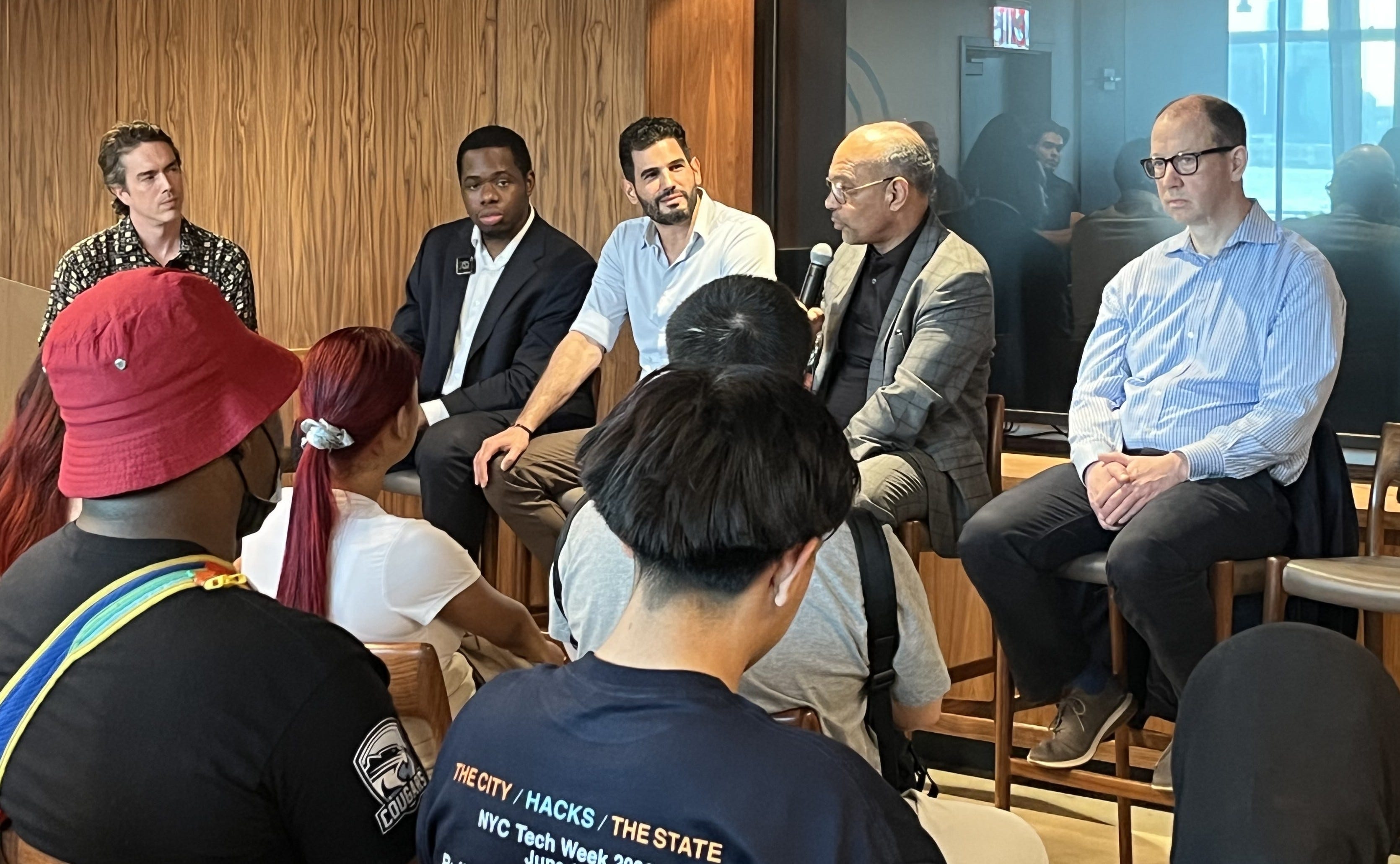
Thursday of last week, I moderated a community panel made up of leaders involved with workforce non-profits delivering tech trainings to young adults around New York City. The event connected community organizations, city agencies, entrepreneurs through the Minority & Women-owned Business Enterprise and, of course, students. The whole event was organized and sponsored by Jea Edman, owner of Johnson Edman Advertising Inc. I owe him and my co-worker at Opportunities for a Better Tomorrow, Charmaine Bourbon, a huge thank you for including me in this event.
So, Jea asked me and Charmaine to help organize the community panel and bring some young adults for the event. He asked Charmaine to moderate the panel, but she, knowing that I had been looking for an opportunity like this, said why don’t we have Grey do it, and I nudged my way in by saying, “Yes, please.”
The goal of the panel in my mind was to explore how non-profits who provide the kind of trainings I oversee can make sure we’re doing the best we can. I had a few big yet nebulous questions floating around my brain:
With AI, and the uncertainty and disruption it’s sure to bring, how do we make sure we’re staying relevant?
How can community organizations do a better job of working together to land these students roles after trainings that get them on a sustainable career path?
How should students think about approaching technology when things are changing so fast?
I have some ideas surrounding these questions that I’ll potentially address in future posts, but for now I’ll focus on what stood out about the panel.
Something I thought about toward the end of the panel was that almost all the panelists’ answers tended toward addressing the young people in the room, even when the question was not asking them to do so. That instinct makes sense; encouraging students to invest in themselves is central to this work, and it matters. But I was also hoping the conversation would turn the lens on us a little. Students can do everything right, acquire every skill, show up every day, and still fall short of a sustainable career if the ecosystem around them isn’t doing its part. The organizations, the employers, the connective tissue between training and real opportunity is where I think there’s still a lot of work to do.
Possibly my favorite part of the conversation was how Bishop Taylor of Urban Upbound spoke about the importance of community organizations working together and coordinating around the best outcomes for the young adults investing their time in our programs. He made a point of saying that this is not a competition and that we have to learn to work better together. The truth is we are competing for some of the same funding and recruiting some of the same students, however, we all win when the students achieve their goals, and their success trumps all organizational and funder-focused metrics.
Another highlight was Tiernan Walsh of Marcy Lab’s candor about students using AI and getting their resume whipped into shape. There was a way that he addressed the students that cuts through the sometimes overly analytical way that I approach some of these questions. His message focused on the bottom line: get your resume in order, apply for jobs, land a job. Don’t let the uncertainty of how AI will affect the tech sector drift you into inaction. Just get on with it.
I want to mention the value of OBT board member Raviv Nadav’s contributions to the panel but also to the work he’s done with the students I work with directly. Raviv has hired our students, given apprenticeships and more recently offered his time to work with students on work readiness. This space needs a lot more people like Raviv who are willing to show up and walk the walk when it comes to giving opportunities to young people. He has a no-nonsense approach that gives students a taste of a real working environment.
Lastly, I have to mention George Nunez from Bronx Tech Hub. George is the panelist who I think connects most seamlessly with our students. Partly because he’s a bit younger, grew up in the Bronx, and has stories that paint a picture recognizable to a lot of our young people. But also because he’s taken his experiences and built on them in a way that is genuinely inspiring, and now he’s giving back.
One thing I wonder about a lot is how useful the work we do actually is to these students. Is there real tangible impact? We shouldn’t be afraid to frame it that way. One thing I’ve felt strongly about in doing this kind of work is that even when the data doesn’t show the impact, we’ve planted seeds that may finally take root years after the trainings end. That said, we must focus on balancing the tangible aspects: jobs, money, sustainability. I ended the panel by saying that students in our programs are investing the most valuable of all resources, their time, and it’s incumbent upon us to do our very best with that resource. Then I said, “Go Knicks,” and I meant that too